
USA Scholarships For Nepalese Students
24 June 2026

Canada is one of the top go-to destinations among international students looking for higher studies. A student visa for Canada, also known as a study permit, allows international students to live and complete their education for a certain period of time. The visa success rate for studying in Canada has subsequently increased to 57% as of 2025 (Jan-Aug), up from around 41% in 2024; this hints at the increase in chances for up to 65% student visa approval in 2026.
Having strong knowledge of student visa requirements, eligibility criteria, fees, and processing time for Canada helps students navigate towards a successful student visa for Canada from Nepal. This blog provides all the necessary information and updates on student visas for Canada from Nepal.
A Canadian student visa is a study permit that allows international students to travel to Canada and get the desired education. This document is issued by Immigration, Refugees and Citizenship Canada (IRCC), providing legal study and residence status for a designated period of time. Depending on the Canadian student visa type, part-time work is permitted during studies and full-time during breaks.
The Canadian government offers different types of student permits depending on applicants' criteria and situations. Some of those visa types are listed below:
The processing time for a Canadian student visa from Nepal is the total time taken to give a verdict on the visa application. It usually takes about 4-12 weeks depending on factors like season, application type, and volume. Despite the stated time, delays occur because of missing financial proof, incomplete forms, or pending medical examinations, often leading towards possible rejection. Proper planning and early submissions remain the top priority for a smoother process.
Key points:
Nepali students must meet all the eligibility criteria set by the government for a Canadian student visa. The fulfillment of these requirements is mandatory and, if not followed, results in student visa rejection. These eligibility criteria are placed by the Canadian government to make sure that the following applicants are genuine. It helps to identify students with strong academic records and financial funds.
Completing these criteria indicates the capacity for adapting to Canadian life and education. The following list contains all the eligibility criteria for a Canadian student visa from Nepal.
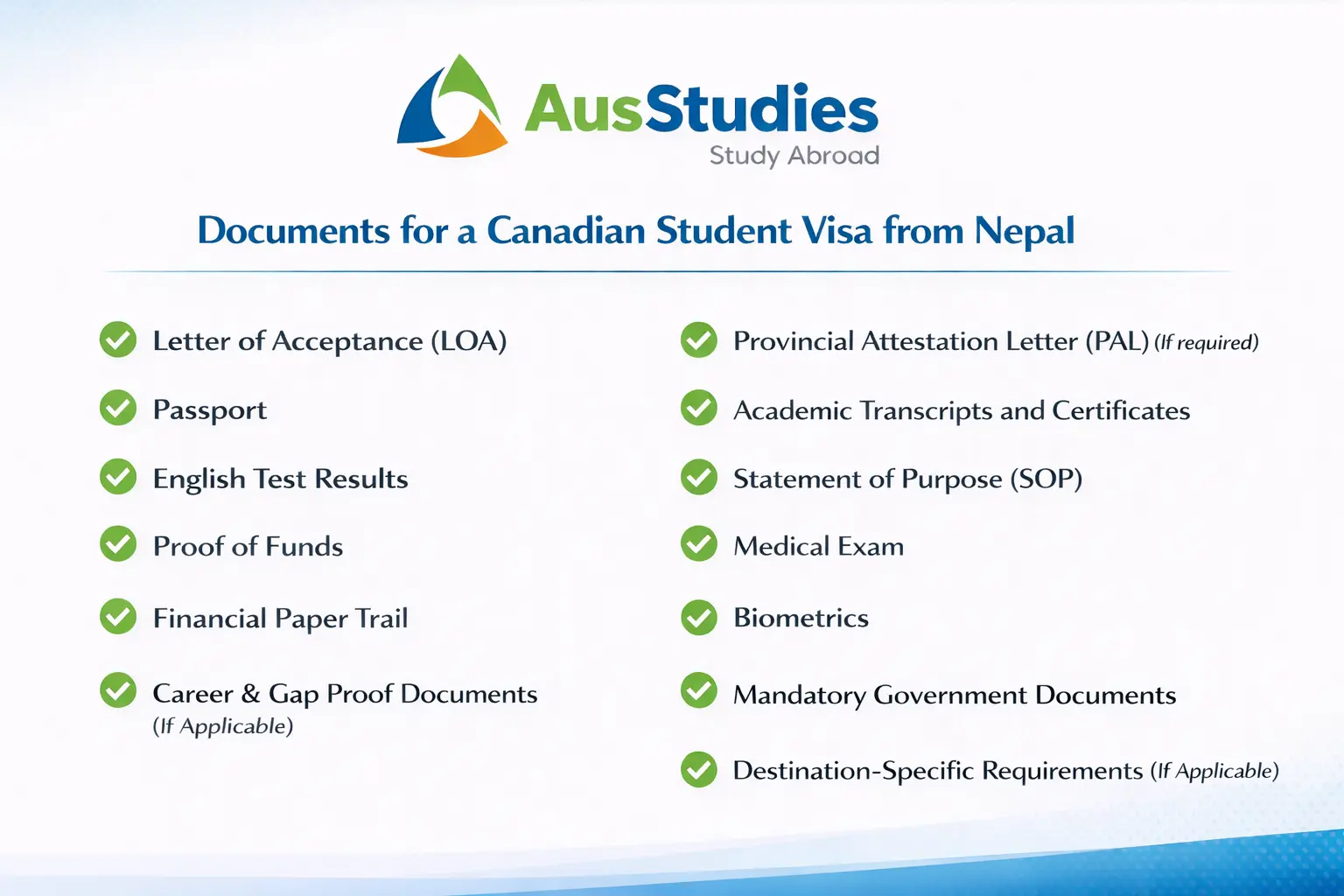
To increase the chances of visa approval, proper collection and submission of documents is crucial for a Canadian student visa from Nepal. The most important document is the Letter of Acceptance (LOA) offered by a recognized Canadian institution. After receiving an LOA, students can apply for a Provincial Attestation Letter (PAL). Other essential documents include passports, academic transcripts, certificates, proof of funds, medical exams, and biometrics, which must be authentic and accurate before submission.
Most of the education institutes require English test results such as IELTS, PTE, TOEFL, etc., which are mandatory for SDS and non-SDS applications. A statement of purpose (SOP) is a professional letter explaining the reason for choosing Canada and plans after the completion of the education. The list of documents for a Canadian student visa from Nepal is listed below:
Note: Proper planning and documentation are often seen as signs of responsibility and readiness as an international student by the immigration officer.
Applicants must have a proper understanding of the total cost about to be spent on a Canadian student visa fee from Nepal. For the vast majority of the time, students tend to only focus on tuition fees, but visa-related spending also plays an important role when it comes to budget management. These expenses cover all the government processing, identity verification, health checks, and language testing requirements for student visas for Canada from Nepal. Being aware of these visa expenses helps students to be prepared and avoid last-minute financial pressure.
Key points:
Nepali students must understand the difference between SDS and non-SDS when applying for a student visa for Canada from Nepal. SDS (Student Direct Stream) and non-SDS are the two main streams applicants can choose when applying for a Canadian student visa. The reason for the existence of the system is to assess students based on documentation, financial proof, and language proficiency.
Student Direct Stream (SDS) is for those students who meet the higher standards and structure requirements, and the application is processed faster as well. While non-SDS is meant for those who didn't fulfill the SDS criteria but are still qualified for a Canadian study permit. The visa processing time for non-SDS students is relatively longer than for SDS. This helps Nepali students choose the path that ensures smooth processing and compliance with the student visa for Canada from Nepal and its requirements.
Key points:
Note: As per details, Student Direct Stream (SDS) had been discontinued on 8 November 2024 to promote equality and fairness among international students.
Canada still remains the top destination among international students, including Nepali students, for education and career growth. A student visa for Canada from Nepal is an access to world-class education with international career opportunities. Nepalese students must understand Canadian requirements, documentation, processing time, and language proficiency for a smooth visa process.
AuStudies guides students aspiring to study in Canada for higher education. We provide expert counselling, accurate documentation support, and personalized visa strategies to make their dream a reality. Move one step closer to your Canadian student visa by visiting us today.